You have the stove, the kindling, the matches. What you don't have is heat, because the logs you bought are damp inside. Buying firewood in the UK is a minefield: sacks sold by the "load", logs that look dry but hiss and steam, and prices that swing wildly from one supplier to the next. Almost everything that matters comes down to two things — how dry the wood is, and how you store it.
Moisture content is the whole game
Freshly felled wood can be more than half water by weight. Burn it and a good share of the heat goes into boiling that water off rather than warming your room. You get a sullen fire, blackened stove glass, steam instead of flame, and tar building up inside the flue.
For a wood burner or an open fire, you want logs under about 20% moisture content. Kiln-dried logs usually arrive somewhere between 10% and 20%. Properly air-dried logs reach the same figure, but it takes time and patience.
A moisture meter costs less than a bag of logs and removes the guesswork. Split a log and push the pins into the freshly exposed inner face, not the weathered end. Test a few logs from different parts of the load — the outside of a log can be bone dry while the middle is still wet. Anything over 20% isn't ready.
Kiln-dried or seasoned: what's the difference?
Seasoned, or air-dried, wood has been split and stacked to dry naturally, usually for a year or more. Kiln-dried wood has been dried in an oven, reaching a usable moisture content in days rather than months.
Neither is automatically better. Kiln-dried is convenient — you can often burn it the day it arrives, and it lights easily — but it costs more, partly because of the energy used to dry it. Well-seasoned wood is cheaper if you have the space and the patience, and it's the obvious choice if you can buy a year ahead. The catch is that "seasoned" is an unregulated word, and plenty of wood sold as seasoned is nothing of the sort.
In England, rules introduced in recent years restrict the sale of wet wood in small volumes, and you'll see the Ready to Burn logo on bags that meet the standard. It's a useful signal, but it applies to small retail sales rather than a trailer load from a local supplier, so you still need to check for yourself.
Which wood to buy
Density determines how much heat you get and how long a log lasts. Dense hardwoods burn slowly and hot; softwoods burn fast and bright and are ideal for getting a fire going.
- Ash — the traditional all-rounder. Splits easily, gives a steady flame, and burns reasonably well even without a long season.
- Oak — dense, long-burning and excellent once dry, but slow to season. Give it two years and it repays you.
- Beech — heavy, clean-burning, good for overnight burns.
- Birch — seasons quickly, decent heat, and the bark makes superb kindling.
- Hawthorn, apple, cherry — dense and fragrant, often available in small quantities from tree surgeons.
- Pine, spruce, larch — resinous and quick to light. Fine for kindling and mixing in, but they leave more deposits in the flue, so don't make them your whole supply.
Most households do best with a mixed load: softwood or birch to establish the fire, hardwood for the long, slow heat.
Avoid anything treated, painted, varnished or glued — old fence panels, pallets, chipboard, MDF. Burning them releases nasties into your room and up the chimney. Driftwood is a poor choice too; the salt it absorbs damages metal stoves and flue liners over time.
Buying: what to ask before you pay
Firewood is sold by volume — a cubic metre, a "load", a builder's bag, a net — and those terms are loose. Two suppliers' cubic metres can look very different once the wood is tipped on your drive.
- When was it felled, split and stacked?
- Is it kiln-dried or air-dried, and what moisture content do they expect?
- Which species are in the load?
- Is that volume measured loose or stacked?
Then look at it. Dry wood feels noticeably light for its size, has grey, cracked ends and loose bark, and gives a hollow knock when two logs are tapped together. Damp wood feels cold and heavy, and the ends look pale and solid. If a supplier can't tell you the moisture content, that tells you something.
Storing it so it stays dry
Dry wood left out in the rain doesn't stay dry. Rain soaks the outer layer, and a permanently wet stack will creep back up towards 25% or more.
The log store that works
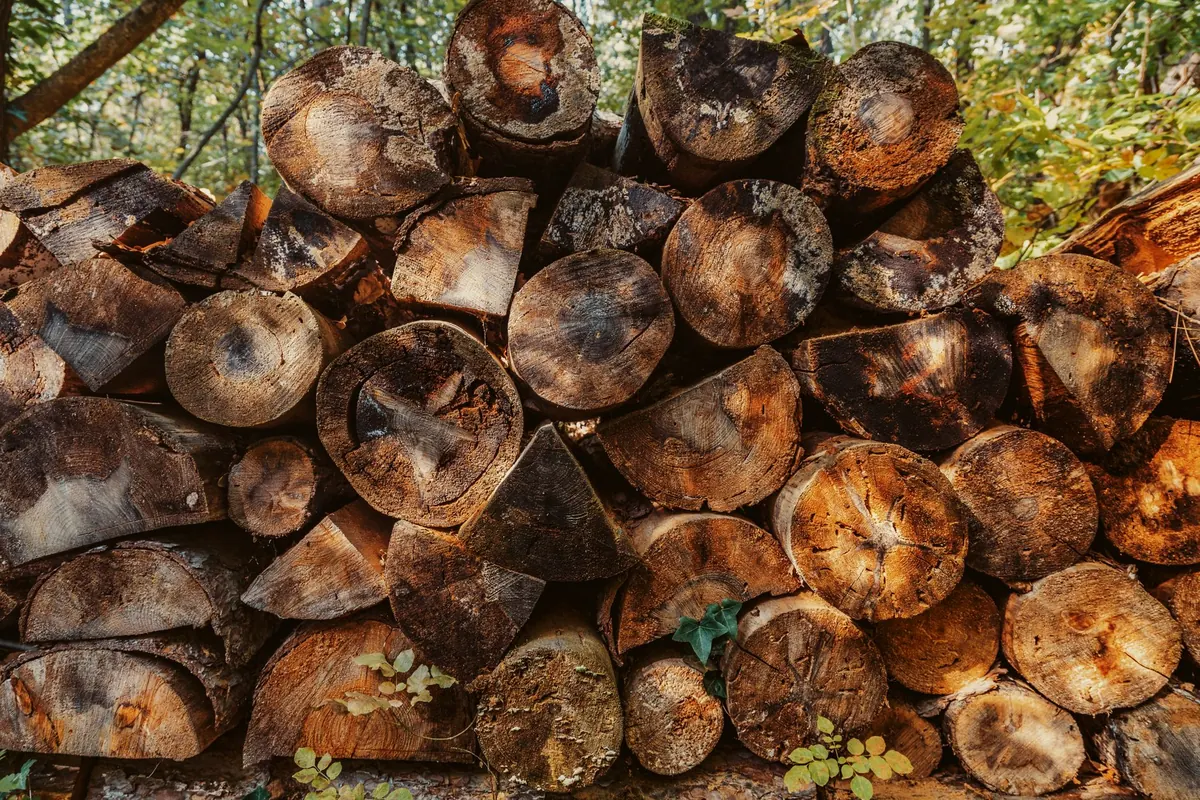
You want airflow, not shelter. Raise the stack off the ground on pallets or bearers, split faces showing, in a spot that catches sun and wind, with a roof over the top and open sides. A store with solid sides and a back panel is a shed, and wood in a shed stays damp.
Stack a single row deep if you have the room — a double row traps moisture in the middle. Lay the top course bark-side up so water runs off. A sheet over the top is fine; never wrap the whole stack.
Indoors
Bring in a few days' worth at a time and let it come to room temperature. Keep the basket a sensible distance from the stove or open fire and check your appliance's clearance instructions — logs are combustible, and heat builds up. A full store pressed against the hearth is a fire risk, not a convenience.
A simple routine for the first year
Buy a moisture meter and check every load. Buy a year ahead if you possibly can: wood stacked this spring will be ready next winter, and you'll never be caught short. Take whatever is cheap and genuinely dry in summer, and keep both hard and soft woods on hand so you can match the fuel to the evening.
If your flue is producing tar or the stove glass blackens within a week, the wood is usually wetter than you think. Have the chimney swept on a regular schedule, and ask a qualified sweep or stove installer for advice if you're unsure — ten minutes of their time will tell you more than a season of guesswork.
Photo: Peter Fazekas / Pexels